
Can Your Employer Deduct From Your UAE Gratuity?
You calculated your gratuity. Your employer’s final settlement number is lower. They say they’re deducting something. Can they do that? Sometimes yes, sometimes no — here’s exactly what Article 25 allows.
You calculated your gratuity. Your employer’s final settlement number is lower. They say they are deducting something. Can they do that?
Sometimes yes, sometimes no. UAE Labour Law is very specific about what employers can and cannot take from your final settlement. This guide explains Article 25 in plain terms, lists every permitted and prohibited deduction, and tells you exactly what to do if you think a deduction is unlawful.
The Legal Basis: Article 25 of Federal Decree-Law No. 33 of 2021
Article 25 of UAE Labour Law is the only source of authority for employers to make deductions from wages and final settlements. There is no other legal basis. If an employer’s deduction does not fall within Article 25, it has no legal standing.
Article 25, as implemented by Article 29 of Cabinet Resolution No. 1 of 2022, permits deductions only in specific categories — covered below.
What Employers CAN Legally Deduct?
Employers CAN deduct
- Outstanding loans or overpayments, if properly documented.
- Employee contributions to approved end-of-service or pension schemes.
- Disciplinary penalties, subject to a 5% limit of the wage.
- Court-ordered debts, subject to applicable legal limits.
- Damage you caused, capped at 5 days’ wage per month.
Employers CANNOT deduct
- Recruitment costs: finding you, bringing you to the UAE, or setting up your visa.
- Training costs, unless a signed agreement with defined repayment terms exists.
- Uniform or equipment costs, unless damaged through proven negligence.
- General business losses from market conditions or client decisions.
- Any deduction without written documentation agreed by both parties.
1. Outstanding loans or overpayments
An employer may recover amounts owed by an employee in relation to loans or wages paid in excess of the employee’s entitlement, subject to the applicable legal requirements and procedures.
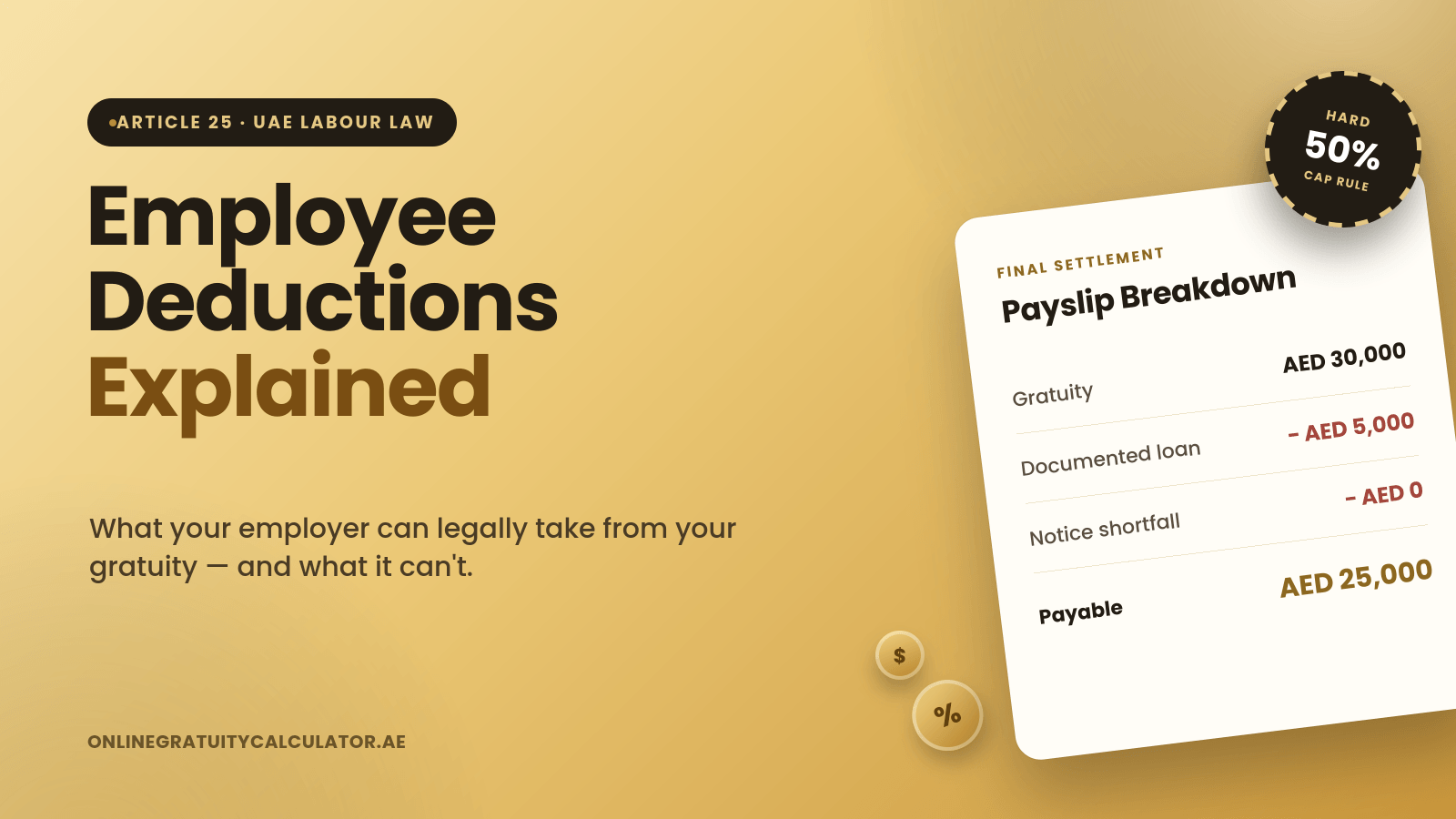
For example: Gratuity AED 30,000, documented outstanding loan AED 5,000. The employer may have a basis to recover the AED 5,000 if the loan is legally due and the applicable requirements have been followed.
2. Employee contributions to approved schemes
Certain contributions that the employee is legally required to make toward end-of-service benefits, retirement pensions, insurance or other approved schemes may be deducted where applicable.
3. Disciplinary penalties
The Labour Law permits certain deductions relating to employee violations where the employer follows the applicable disciplinary procedures and regulations. For wage deductions under Article 25, penalties for violations are subject to a 5% limit of the wage. A disciplinary deduction should therefore not simply be described as an arbitrary “fine” imposed by an employer.
4. Court-ordered debts
An employer may deduct amounts that are payable under a court judgment, subject to the applicable legal limits and procedures. If your employer claims that a deduction is based on a court order, ask for the relevant documentation.
5. Damage caused by the employee
The law allows certain deductions where a worker’s mistake or violation of the employer’s instructions causes damage, destruction or loss of company tools, machines, products or materials. However, specific limits and procedures apply. Under Article 25, the amount deducted for this type of damage cannot exceed the worker’s wage for five days per month, unless a competent court approves a higher amount.
What Employers CANNOT Legally Deduct?
These deductions are illegal under UAE Labour Law, regardless of what the employment contract says:
- Recruitment costs: the cost of finding you, bringing you to the UAE, or setting up your visa.
- Training costs: unless you signed a specific, separate training agreement with defined repayment conditions and service commitment, and you are leaving within the agreed period.
- Uniform or equipment costs: unless the employee damaged items through proven negligence.
- General business losses: losses caused by market conditions, client decisions, or commercial outcomes are not the employee’s liability.
- Deductions as punishment: performance-based penalties not specified in the contract.
- Administrative or processing fees: no such deductions exist under UAE law.
- Any deduction without written documentation agreed by both parties.
What About Visa and Recruitment Costs?
This is one of the most common questions employees ask: can my employer deduct visa costs from my gratuity in the UAE?
Generally, employers are prohibited from charging workers recruitment and employment fees and costs, directly or indirectly. The UAE Government also confirms that employers bear recruitment and travel-related costs for foreign workers. Therefore, an employer should not simply deduct ordinary recruitment or employment costs from your final settlement because the company paid them when you were hired.
If you believe your employer has deducted such costs, keep copies of the following (these records can be useful if you need to raise a labour complaint):
- Your employment contract
- Job offer
- Payslips
- Final settlement
- Any email or WhatsApp message mentioning the deduction
- Any document showing what the employer says you owe
Can an Employer Deduct Training Costs From Gratuity?
Training-related deductions require more careful examination. The UAE Labour Law places obligations on employers relating to developing workers’ skills and providing minimum training, qualification and empowerment programmes. Therefore, an employer should not automatically treat every training expense as a debt owed by the employee.
If your employer says you must repay training expenses, ask for:
- The written agreement relating to the training.
- The exact amount being claimed.
- The contractual or legal basis for the repayment.
- Evidence that the amount is actually due.
- Details of how the amount has been calculated.
Do not assume that a clause in an employment contract automatically makes every deduction lawful. The deduction must still comply with applicable UAE employment legislation.
The 50% Cap: The Most Important Limit Most Employees Never Know
Even where deductions are permitted, Article 25 sets a hard ceiling: total deductions from any periodic wage payment, including the final settlement, cannot exceed 50% of the periodic wage.
This means if your basic salary is AED 10,000 per month and your total final settlement (gratuity + leave + unpaid salary) is AED 50,000, your employer cannot deduct more than AED 5,000 per pay cycle. They may need to spread deductions across multiple cycles, or take the matter to court to recover larger amounts.
Examples of UAE Gratuity Deductions
Example 1: Documented Employee Loan
An employee has a gratuity of AED 30,000 and an outstanding documented loan of AED 5,000.
| Item | Amount |
|---|---|
| Gratuity | AED 30,000 |
| Documented outstanding loan | − AED 5,000 |
| Employee’s final amount | AED 25,000 |
If the loan is legally due and the employer has complied with the applicable requirements, the employer may have a basis to recover the outstanding amount. The exact outcome depends on the documentation and applicable legal requirements.
Example 2: Recruitment Fee
An employee has a gratuity of AED 30,000. The employer claims AED 5,000 for recruitment expenses.
| Item | Amount |
|---|---|
| Gratuity | AED 30,000 |
| Employer’s recruitment-fee claim | Not a lawful deduction |
| Amount owed | AED 30,000 |
Article 6 prohibits employers from charging workers recruitment and employment fees and costs directly or indirectly. A recruitment cost should therefore not simply be treated as an employee debt because the employer incurred the expense during hiring.
Example 3: Damage to Company Property
Suppose an employee accidentally causes documented damage to company property. The employer may have a potential claim if the statutory conditions are satisfied. However, Article 25 sets a specific limit for wage deductions relating to this type of damage: generally no more than the worker’s wage for five days per month, unless a competent court approves a greater deduction. The employer should also follow the applicable procedures rather than simply removing an arbitrary amount from the final settlement.
Can Banks Deduct From Your Gratuity?
Yes — but only if you signed a loan agreement that included a clause authorising the bank to claim your end-of-service benefits in case of default. This is a separate contractual arrangement between you and your bank, not governed by the employer-employee deduction rules.
To protect yourself:
- Check your loan agreements before resigning.
- Consider having your gratuity paid to a bank account where you have no outstanding loans.
- If possible, settle any bank loans before your employment ends.
How to Challenge an Illegal Deduction?
- Request the written documentation behind the deduction from your employer immediately. Ask for the signed loan agreement, advance record, damage report, or court judgment that authorises it.
- If they cannot produce documentation, state in writing that you dispute the deduction and consider it unlawful under Article 25.
- File a MOHRE complaint at mohre.gov.ae or call 800-60. The burden of proof in MOHRE mediation sits with the employer; they must prove the deduction is lawful, not you.
- Keep all records including your payslips, your own gratuity calculation, and any correspondence about the deduction.
Legal vs Illegal
| Deduction type | Legal? |
|---|---|
| Documented salary loan within 50% cap | Yes |
| Documented salary advance within 50% cap | Yes |
| Unpaid notice period days | Yes |
| Court-ordered repayment | Yes |
| Proven property damage with evidence | Yes |
| Recruitment or visa costs | No |
| Training costs (no signed agreement) | No |
| Uniform or equipment costs | No |
| Business losses or poor performance | No |
| Deductions without written documentation | No |
| Deductions exceeding 50% of periodic wage | No |
Conclusion
An employer cannot simply reduce your UAE gratuity by any amount it chooses. UAE Labour Law and its implementing regulations identify circumstances in which amounts may be recovered from wages or end-of-service benefits, including certain loans, overpayments, approved contributions, disciplinary penalties, court-ordered debts, and qualifying damage claims. At the same time, employers are prohibited from charging workers recruitment and employment costs directly or indirectly.
If your final settlement is lower than expected, ask for a written gratuity and deduction breakdown, collect the supporting documents, and compare the calculation with the applicable UAE Labour Law provisions. If you believe your employer has made an unlawful deduction or failed to pay your entitlements, you can contact MoHRE and use the applicable labour-dispute process.
Calculate your expected UAE gratuity before accepting your final settlement: use our free UAE Gratuity Calculator to estimate your end-of-service benefit.
Frequently asked questions
Can my employer deduct money from my gratuity?
Yes. UAE law permits certain deductions from end-of-service benefits where the amount is legally due and the applicable conditions and procedures are satisfied.
Can my employer deduct visa costs from my gratuity?
Employers are generally prohibited from charging workers recruitment and employment fees or costs directly or indirectly.
Can an employer deduct a loan from gratuity?
Potentially yes, if the loan is legally due and the applicable requirements for recovery have been met. The implementing regulation expressly includes recovery of loans and overpayments among the amounts that may be deducted from end-of-service benefits.
Is the 50% rule applicable to gratuity?
Article 25 contains a 50% maximum for total deductions or withholding from wages where multiple deductions apply. However, deductions from end-of-service benefits are separately addressed by the implementing regulation, so the 50% figure should not be treated as a blanket rule that an employer can simply apply to every gratuity payment.
Can my employer deduct money for damaged company property?
Potentially, if the statutory requirements are satisfied. Article 25 specifically addresses damage caused by a worker’s mistake or violation of the employer’s instructions and places a limit on the amount that may be deducted from wages without court approval.
What if I disagree with the deduction?
Ask your employer for a written breakdown and supporting documents. If the dispute cannot be resolved, you can raise an individual labour dispute with MoHRE under the applicable procedure.
How is UAE gratuity calculated?
For eligible full-time expatriate workers, gratuity is generally calculated using the basic salary. Employees who have completed at least one year of continuous service may be entitled to gratuity, subject to the conditions in the Labour Law.
Get new guides in your inbox
Occasional updates on UAE gratuity rules, settlement tips, and new calculator features. No spam — placeholder copy you can edit.
Prefer to run the numbers now? Open the calculator →