
How Many Warnings Before Termination in the UAE?
UAE Labour Law does not set a fixed number of warnings before dismissal — here is what Article 44 actually says, and what protects you.
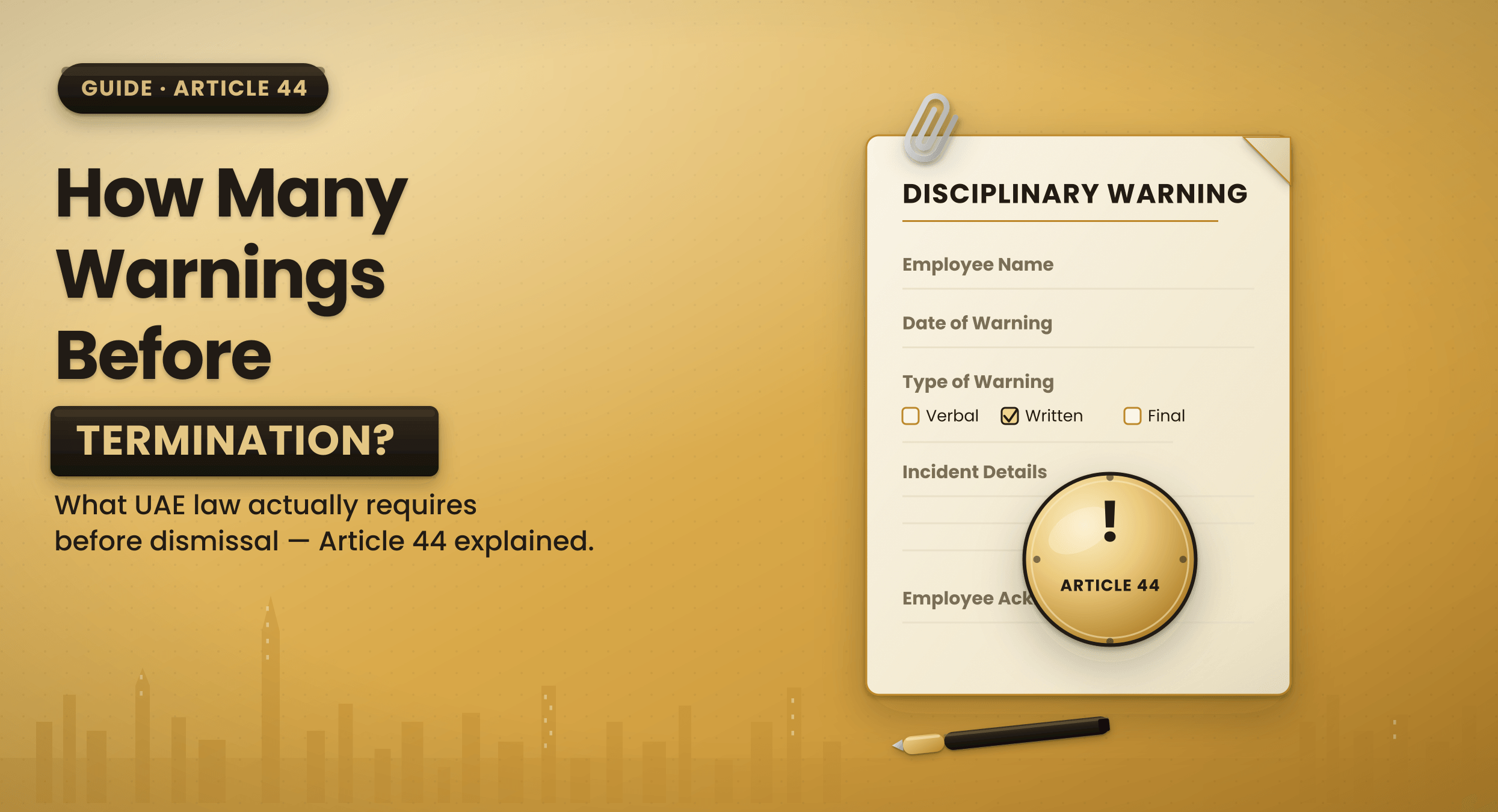
Receiving a warning from your employer can be stressful, especially if you are worried it could lead to termination. A common question employees ask is: “How many warnings can I receive before my employer can fire me?”
The answer may be surprising: UAE Labour Law does not say that an employer must give an employee one, two, or three warnings before termination. Instead, Federal Decree-Law No. 33 of 2021 sets out specific circumstances in which an employer can dismiss an employee without notice — covered mainly under Article 44. For other situations, the employer must consider the nature of the misconduct, the employment contract, company policies, and the required disciplinary process.
Is there a legal number of warnings before termination?
UAE Labour Law does not specify that an employer must give 1, 2, or 3 warnings before terminating an employee. What the law does specify is the circumstances under which an employer can terminate, and what protections employees have against unfair dismissal.
In practice, most employment contracts and company HR policies include a progressive disciplinary process — verbal warning, written warning, final written warning — but this is contractual, not a legal requirement. The absence of this process can support an arbitrary dismissal claim.
Article 44: when can an employer dismiss without notice?
Article 44 of Federal Decree-Law No. 33 of 2021 lists the only situations in which an employer can terminate immediately, without notice and without a prior warning process:
| # | Situation | What it means |
|---|---|---|
| 1 | False identity or documents | Employee provided fraudulent documents during hiring |
| 2 | Causing financial loss to employer | Actions resulted in significant material damage; employer must notify MOHRE within 7 business days |
| 3 | Violating workplace safety rules | Breach causing serious harm or danger to others |
| 4 | Disclosing confidential information | Trade secrets or confidential data shared without authorisation |
| 5 | Intoxicated or on drugs at work | Employee was under the influence during working hours |
| 6 | Assault at work | Physical or verbal assault on employer, supervisor, or colleague |
| 7 | Absence for 7+ consecutive days | Unauthorised absence for 7 or more days in a row without valid reason |
| 8 | Absence 20+ days in a year | Cumulative unauthorised absence exceeding 20 days in 12 months |
| 9 | Exploiting position for personal gain | Using job role to gain personal benefits at the company’s expense |
| 10 | Working for a competitor | Employed by a competing business without written employer permission |
The investigation requirement before dismissal
Even for Article 44 grounds, UAE law requires the employer to follow a proper process before dismissal. Specifically:
- The employer must conduct a written investigation into the alleged misconduct.
- The employee must be given the chance to respond to the allegations in writing.
- The investigation and response must be documented in the employee’s file.
- The dismissal decision must be issued in writing, stating the reason.
- For cases involving material loss or damage, MOHRE must be notified within 7 working days.
If the employer skips this process and simply dismisses the employee, the dismissal may be found to be arbitrary — even if the underlying conduct was genuinely serious.
What is arbitrary dismissal, and what can you claim?
If your employer terminates you for a reason not listed in Article 44, and that reason is not sufficiently serious to justify termination even under the general employment contract terms, this is arbitrary dismissal under Article 47.
You are entitled to:
- Your full gratuity based on years of service.
- Notice period pay, or the salary equivalent if notice was not served.
- Compensation of up to 3 months’ basic salary for the arbitrary nature of the dismissal.
What to do if you receive a disciplinary warning
- Read the warning carefully. Note whether it is verbal or written — a verbal warning has little legal weight unless also confirmed in writing.
- Respond in writing. Even if you disagree, send a measured written response to HR stating your perspective and keep a copy. This creates a paper trail.
- Check your employment contract. Many contracts set out a specific disciplinary process — if the employer deviates from it, that is a contractual breach.
- Do not resign under pressure. Resigning means you forgo any arbitrary dismissal compensation. Take time to assess.
- If dismissed, file a MOHRE complaint immediately. You have 1 year from dismissal to file — do not wait.
What should a formal warning letter include?
A well-documented disciplinary warning should clearly explain what the employee is alleged to have done and why the employer considers it a violation.
| Element | What it should contain |
|---|---|
| Employee details | Employee’s name, ID, job title and department |
| Date | Date the warning was issued |
| Type of warning | Verbal warning confirmed in writing, written warning, or final warning |
| Incident details | Clear description of the alleged incident, including relevant dates |
| Policy or rule | The company policy, contractual obligation, or rule involved |
| Required improvement | What the employee is expected to change or correct |
| Future consequences | What may happen if the issue is repeated |
| Employee acknowledgment | Confirmation that the employee received the warning |
| HR/management details | Name and signature of the authorised representative |
Conclusion
UAE law does not require a fixed number of warnings before termination. What it does require is that terminations for non-Article 44 reasons are fair, properly documented, and not arbitrary. If you are dismissed without valid grounds or proper process, you have a strong claim for arbitrary dismissal compensation on top of your full gratuity.
Check your own gratuity amount right now using our free UAE Gratuity Calculator.
Frequently asked questions
My employer dismissed me without any warning at all. Is that legal?
It depends on whether the dismissal was for one of the Article 44 grounds. If not, the lack of any warning process supports an arbitrary dismissal claim. File a MOHRE complaint.
I received a warning but the reason was unfair. What can I do?
Respond in writing to HR immediately, stating your disagreement and the facts as you see them. Keep the response professional and factual. If the situation escalates to dismissal, your written response forms part of your evidence in a MOHRE complaint.
Does receiving a warning affect my gratuity?
No. Receiving a disciplinary warning does not affect your gratuity entitlement. Even being dismissed under Article 44 does not automatically remove your right to gratuity under the 2021 law.
My employer issued a backdated warning. Is that valid?
Backdated warnings are a serious issue. They are not valid if the employee was not aware of the alleged incident at the time it supposedly occurred. Backdating is evidence of bad faith and strengthens an arbitrary dismissal claim significantly.
Get new guides in your inbox
Occasional updates on UAE gratuity rules, settlement tips, and new calculator features. No spam — placeholder copy you can edit.
Prefer to run the numbers now? Open the calculator →