
UAE Labour Law 2026: A Complete Guide for Employees
All the updates on your contract, notice period, leave, and gratuity — and the rights every private-sector employee should know.
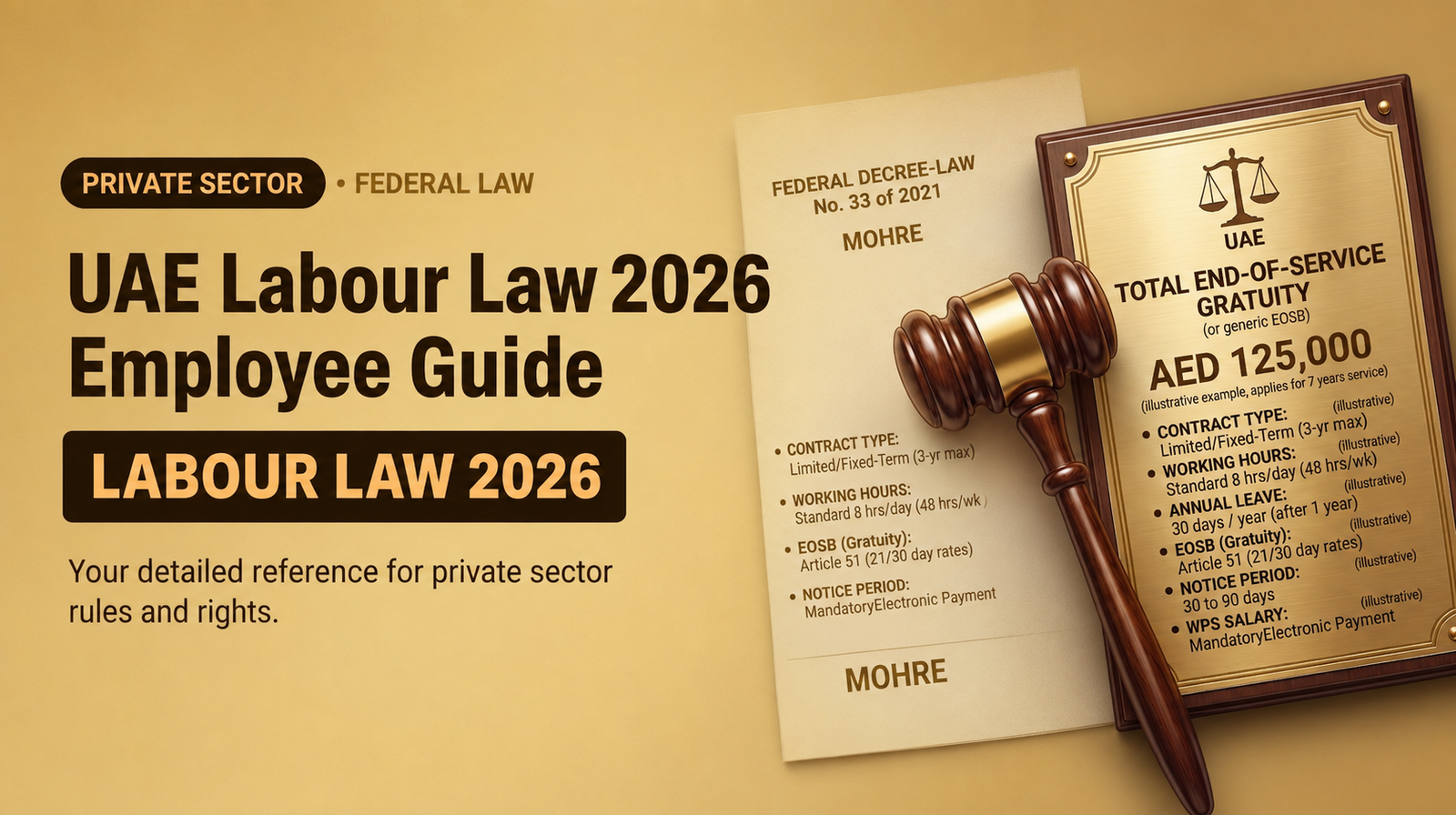
Most UAE employees are unaware of their rights. It pays to know the rules around your contract, notice period, annual leave, and gratuity — because UAE law gives employees strong protection.
This is a complete guide to what you need to know as a private-sector employee in 2026.
Understanding the employment law: Federal Decree-Law No. 33 of 2021
Most private-sector employees in the UAE are covered by Federal Decree-Law No. 33 of 2021 on the Regulation of Labour Relations. This law replaced the old UAE Labour Law (Federal Law No. 8 of 1980) and came into effect on 2 February 2022. The detailed rules are set out in Cabinet Resolution No. 1 of 2022, which explains how the law applies in real work situations.
The main government authority for labour matters is MOHRE, the Ministry of Human Resources and Emiratisation, which is responsible for checking that employers follow the law. The law covers many important employment matters:
Employment contracts in the UAE
From February 2023, all UAE private-sector employees work under a limited contract, also called a fixed-term contract. Unlimited contracts are no longer used, and any old unlimited contract had to be converted to a limited contract by February 2023.
| Contract feature | Rule under the 2021 law |
|---|---|
| Only permitted type | Limited (fixed-term) contract |
| Maximum initial duration | 3 years (renewable) |
| Language | Must be in Arabic; a translation is permitted |
| MOHRE registration | Mandatory — your contract must be registered |
| If there is no written contract | Oral terms apply; the employee can prove terms by any means |
| Probation maximum | 6 months — cannot be extended |
Working hours
Your normal working time should not exceed 8 hours a day or 48 hours a week, unless your job falls under an exception allowed by law. If you work extra hours, you are entitled to overtime pay.
| Category | Standard |
|---|---|
| Normal working hours | 8 hours per day, 48 hours per week |
| During Ramadan (Muslim employees) | Reduced by 2 hours per day |
| Overtime rate (first 2 hours daily) | 125% of the normal hourly rate |
| Overtime on rest days | 150% of the normal hourly rate |
| Maximum overtime (excluding exceptions) | 2 hours per day |
Annual leave
Annual leave is your paid holiday from work. The number of days depends on how long you have worked for the company, or what your contract states. After one year of service, you are entitled to 30 calendar days of paid annual leave every year. Leave also continues to build up during your notice period, so any unused leave must be paid out in your final settlement.
| Service period | Annual leave entitlement |
|---|---|
| First 6 months | No paid leave (can be taken with employer approval) |
| 6 months to 1 year | Pro-rata (2 days per month worked) |
| After 1 year of service | 30 calendar days per year |
| Encashment on exit | Unused leave paid out at the daily basic wage rate |
Sick leave
After your probation period, you can take up to 90 days of sick leave in a year — some paid, some half-paid, and some unpaid. You may need to provide a medical certificate to support your sick leave.
| Sick leave period | Pay level |
|---|---|
| First 15 days | Full pay (100%) |
| Next 30 days | Half pay (50%) |
| Remaining 45 days | Unpaid |
| During probation | Unpaid |
Other leave types
The law also provides leave for specific situations. For maternity leave, the first 45 days are paid at full salary and the next 15 days at half salary.
| Leave type | Entitlement |
|---|---|
| Maternity leave | 60 calendar days: first 45 at full pay, next 15 at half pay |
| Paternity leave | 5 working days within 6 months of the birth |
| Bereavement leave | 5 days for a spouse or child; 3 days for a parent, sibling, or grandparent |
| Hajj leave | 30 days unpaid, once in service (Muslim employees only) |
| Study leave | 10 days per year for employees with 2+ years’ service (approved exam) |
End-of-service gratuity: the formula
Gratuity is one of the most important employee benefits in the UAE — the amount your employer pays when your job ends, provided you have completed at least one year of continuous service. It is calculated on your basic salary only, and does not include housing, transport, commission, bonus, or any other allowance. The formula is based on Article 51 of the UAE Labour Law.
You can run your own numbers in seconds with our UAE Gratuity Calculator.
| Years of service | Gratuity rate | Maximum payable |
|---|---|---|
| Less than 1 year | No gratuity | N/A |
| 1 to 5 years | 21 days’ basic salary per year | Proportional |
| More than 5 years | 30 days per additional year after the first 5 | 24 months’ basic salary (cap) |
Termination and notice period
Your job can end in different ways — you may resign, or your employer may terminate your contract. In most cases a notice period is required. Your exact notice period is usually written in your contract, but the law says it must be between 30 and 90 days.
| Situation | Notice required |
|---|---|
| Standard resignation or termination | 30 to 90 calendar days (as per contract) |
| Minimum notice (enforced by law) | 30 calendar days |
| Maximum notice (enforced by law) | 90 calendar days |
| During probation: leaving the UAE | 14 calendar days |
| During probation: joining another UAE employer | 30 calendar days |
| Termination for gross misconduct (Article 44) | No notice required |
Termination without notice
In some serious cases, an employer can terminate an employee without notice. These are listed under Article 44 of the UAE Labour Law and include:
- Fraud, impersonation, or false documents.
- Physical assault on a colleague, supervisor, or employer.
- Repeated intoxication at work.
- Disclosure of confidential business information.
- Theft or intentional damage to company property.
- Unauthorised absence for 7 or more consecutive days, or 20 days in a year.
- Violation of safety rules causing serious harm.
Even so, the employer must follow the proper process. In most cases they must carry out a written investigation before dismissing the employee, and if the issue involves serious loss or damage they must inform MOHRE within 7 working days.
Unfair dismissal
Unfair dismissal — also called arbitrary dismissal — happens when an employer terminates an employee without a valid legal reason. If the dismissal is unfair, the employee may receive compensation of up to 3 months’ basic salary. This compensation is separate from other payments, such as:
- Notice period pay.
- End-of-service gratuity.
- Unpaid salary.
- Unused annual leave payment.
Salary payments and WPS
Every UAE employer must pay salaries through the Wage Protection System (WPS), an electronic salary payment system that helps MOHRE check whether employers are paying on time. If an employer delays salary payments, MOHRE can take action. Keep your salary records, payslips, bank statements, and employment documents safe.
| Days late | MOHRE action |
|---|---|
| 3 days late | Warning issued to the employer |
| 10 days late | Second formal reminder |
| 17 days late | Work permit suspension for new hires |
| 30 days late | Case referred for criminal prosecution |
Final settlement
When your employment ends, your employer must pay your final settlement. Under Article 53, it should be paid within 14 calendar days of your last working day. Your final settlement may include:
- Unpaid salary.
- End-of-service gratuity.
- Payment for unused annual leave.
- Notice period pay, if applicable.
- Any other amount stated in your contract.
If your employer does not pay on time, you can file a complaint with MOHRE. Employers who delay final settlements may face complaints, labour court cases, and fines.
How to file a MOHRE complaint
If your employer does not follow the law, you can file a complaint with MOHRE through any of these channels:
- The MOHRE website.
- The MOHRE Smart App.
- The MOHRE call centre at 800-60.
After you file, MOHRE will contact your employer and try to resolve the issue. If it cannot be solved, the case may be sent to the Labour Court. Before filing, keep these documents ready:
- Employment contract.
- Salary slips.
- Bank statements.
- Emails or WhatsApp messages with your employer.
- Termination letter, if any.
- Resignation letter, if any.
- Any other proof related to your complaint — good records make your case stronger.
Some important legal references
| Topic | Legal reference |
|---|---|
| Main employment law | Federal Decree-Law No. 33 of 2021 |
| Executive Regulations | Cabinet Resolution No. 1 of 2022 |
| EOSB savings scheme | Cabinet Resolution No. 96 of 2023 |
| Gratuity formula | Article 51 of Federal Decree-Law No. 33 of 2021 |
| Final settlement deadline | Article 53 of Federal Decree-Law No. 33 of 2021 |
| Permitted deductions | Article 25 of Federal Decree-Law No. 33 of 2021 |
| Termination grounds | Article 44 of Federal Decree-Law No. 33 of 2021 |
| Arbitrary dismissal | Article 47 of Federal Decree-Law No. 33 of 2021 |
| Notice period | Article 43 of Federal Decree-Law No. 33 of 2021 |
Final thoughts
UAE Labour Law gives private-sector employees many important rights. These are the ones worth remembering:
The rights that matter most
- Your gratuity is calculated under Article 51.
- Your final settlement must be paid within 14 days under Article 53.
- Your notice period should usually be between 30 and 90 days under Article 43.
- You can file a free complaint with MOHRE if your employer breaks the law.
Knowing your rights helps you avoid confusion and protect yourself at work. Use our free UAE Gratuity Calculator to check your estimated end-of-service payment in just a few seconds.
Get new guides in your inbox
Occasional updates on UAE gratuity rules, settlement tips, and new calculator features. No spam — placeholder copy you can edit.
Prefer to run the numbers now? Open the calculator →