
UAE Labour Law: What Has Changed, 2023 vs 2026?
A year-by-year breakdown of every major change since the new law took effect — contracts, gratuity, savings schemes, and bankruptcy protections.
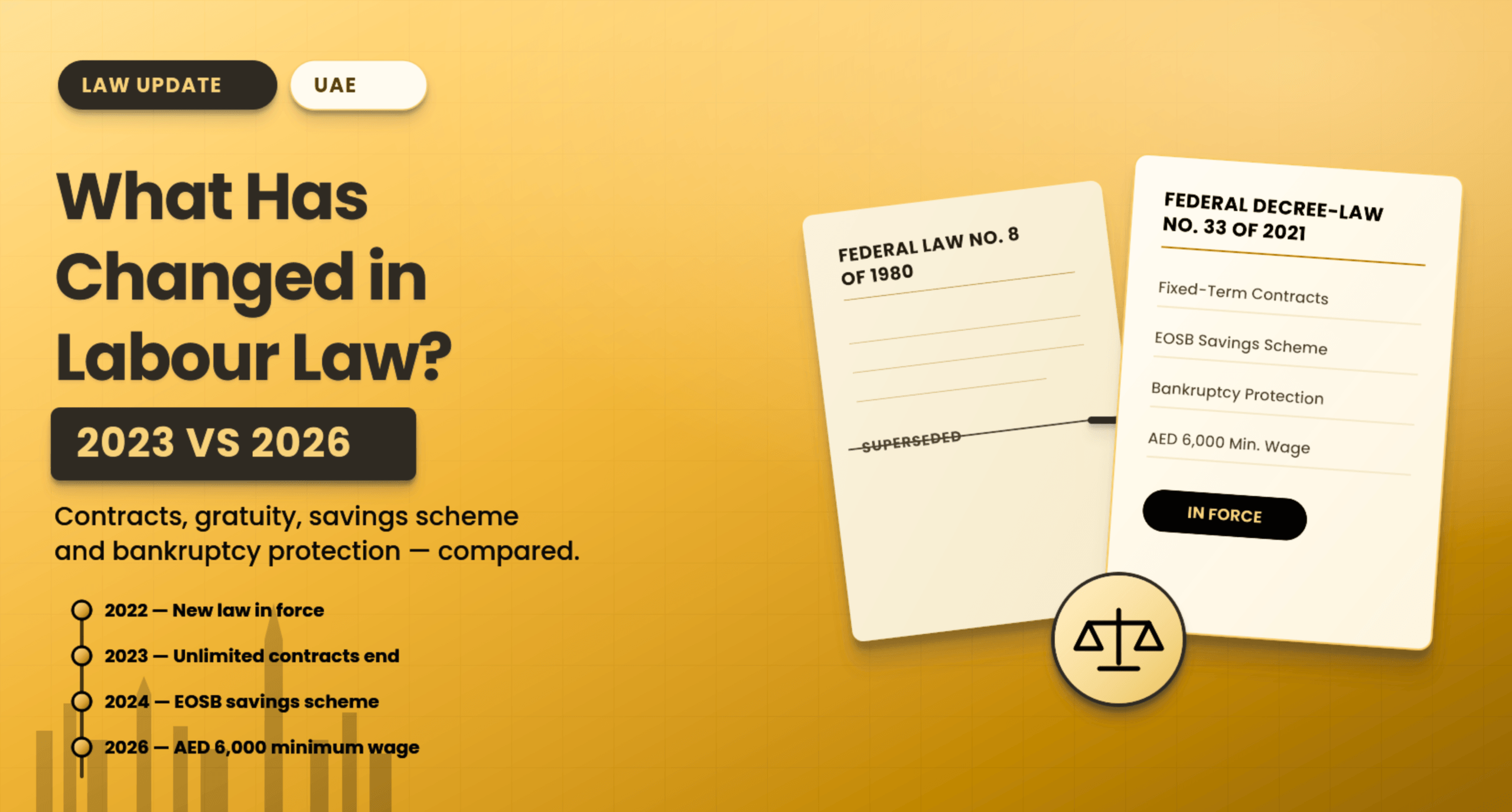
UAE Labour Law has changed significantly in the past few years. If you started working in the UAE before 2022, the rules you knew when you joined are not the same rules that apply today.
This guide runs you through a chronological breakdown of every major change from the old law to today, what each change means in practice, and how it affects your gratuity and employment rights. The biggest changes include the move from unlimited to fixed-term employment contracts, changes to end-of-service benefits, the introduction of the voluntary EOSB Savings Scheme, stronger employee protections, and the AED 6,000 minimum salary requirement for Emiratis in the private sector.
The timeline at a glance
The current UAE private-sector labour framework is based primarily on Federal Decree-Law No. 33 of 2021 and its amendments, which replaced Federal Law No. 8 of 1980.
| Date | Change made |
|---|---|
| February 2022 | Federal Decree-Law No. 33 of 2021 came into force — replaced the 1980 law |
| February 2023 | Unlimited contracts abolished — all contracts must now be limited (fixed-term) |
| January 2024 | Ministerial Resolution No. 668 of 2023 introduced EOSB Savings Scheme details |
| May 2024 | Federal Decree-Law No. 51 of 2023 (Bankruptcy Law) came into force |
| January 2026 | Emirati private-sector minimum wage increased to AED 6,000 per month |
| Ongoing 2026 | Continued Emiratisation enforcement with increased penalties |
Change #1: the new law replaced the 1980 law
One of the biggest changes happened on 2 February 2022, when Federal Decree-Law No. 33 of 2021 came into force, replacing Federal Law No. 8 of 1980, which had governed private-sector employment in the UAE for more than 40 years.
| Topic | Old law (pre-2022) | New law (2022 onwards) |
|---|---|---|
| Resignation gratuity (unlimited contract) | Reduced: 1/3 for 1–3 yrs, 2/3 for 3–5 yrs | Full gratuity for limited contracts; same brackets remain for legacy unlimited |
| Misconduct dismissal and gratuity | Article 120: employer could withhold gratuity completely | Article 44: gratuity generally still payable after 1 year, employer pursues separate claim |
| Contract types | Limited and unlimited both permitted | Limited (fixed-term) only for new contracts |
| Non-compete clauses | Broadly enforceable | Restricted: only valid if role-specific, time-limited, and geographically reasonable |
| Work permit ban after resign | Could be imposed freely | Restrictions removed for most cases under new rules |
| Maternity leave | 45 days | 60 calendar days (45 full pay, 15 half pay) |
| Paternity leave | Not in law | 5 working days within 6 months of birth |
The current law also introduced additional work models and strengthened protections against matters such as discrimination, harassment, bullying and workplace abuse.
Change #2: unlimited contracts were abolished (February 2023)
One of the most important changes for UAE employees was the move away from unlimited employment contracts. Under the new labour framework, employment contracts in the private sector are fixed-term. Existing unlimited contracts were required to be converted to fixed-term contracts under the transitional provisions.
Before the new law, employees could have either limited-term or unlimited-term contracts. Today, new private-sector employment contracts are generally structured as fixed-term contracts — a change that also affected the way employees think about resignation and gratuity.
Change #3: the EOSB voluntary savings scheme (2023 onwards)
Cabinet Resolution No. 96 of 2023 introduced an alternative to traditional gratuity: the voluntary End-of-Service Benefits Savings Scheme. Under this scheme, employers can opt in and, instead of owing a lump sum at the end, make monthly contributions into a regulated investment fund in each employee’s name.
- It is voluntary for employers, not mandatory — your employer decides whether to enrol.
- Employees enrolled in the scheme are no longer covered by the traditional gratuity formula.
- Contributions are held by an SCA-regulated fund — completely ring-fenced from the company.
- If the company goes bankrupt, enrolled employees’ savings are fully protected.
- Any gratuity accrued before enrolment must be settled separately.
Change #4: bankruptcy law protection for employees (May 2024)
Federal Decree-Law No. 51 of 2023 on Financial Restructuring and Bankruptcy came into force on 1 May 2024, significantly strengthening employee protections in insolvency situations.
Under the new bankruptcy law, employees are preferential creditors. Their claims for unpaid wages (up to 3 months) and end-of-service gratuity must be settled before unsecured commercial creditors — this applies even during preventive settlement and restructuring, since the moratorium on other creditor claims does not freeze employment entitlements.
Change #5: higher Emirati minimum wage (January 2026)
From 1 January 2026, the minimum wage for UAE nationals working in the private sector increased from AED 5,000 to AED 6,000 per month. Employers who do not meet this threshold face penalties under Emiratisation enforcement rules.
For expatriate employees, there is still no universal minimum wage under UAE federal law as of June 2026, though immigration authorities use salary benchmarks when approving work permits.
What has NOT changed about UAE gratuity?
Despite the major labour law changes, the basic statutory gratuity calculation for eligible full-time employees remains straightforward.
You can run your own numbers in seconds with our UAE Gratuity Calculator.
Conclusion
The biggest changes in recent years have been the abolition of unlimited contracts (which removed the old penalty system for resigning employees), the introduction of the voluntary EOSB Savings Scheme (which protects gratuity even from employer insolvency), and the new bankruptcy law (which makes employees preferential creditors).
If you joined the UAE after February 2022, you are under the new law entirely. If you joined before, some transitional rules may apply to your pre-conversion service period. When in doubt, run the numbers with our Calculator and then verify with MOHRE.
Frequently asked questions
What changed in UAE Labour Law in 2022?
Federal Decree-Law No. 33 of 2021 came into force on 2 February 2022 and replaced Federal Law No. 8 of 1980. It introduced a new framework for employment contracts, work models, employee protections, leave and end-of-service benefits.
Are unlimited contracts still allowed in the UAE in 2026?
No. The current UAE private-sector framework provides for fixed-term employment contracts only. Unlimited contracts were required to transition to fixed-term contracts under the new labour framework.
Has UAE gratuity changed in 2026?
The standard gratuity formula for eligible full-time employees remains 21 days of basic salary for each year during the first five years and 30 days for each additional year, subject to the applicable rules and a maximum of two years’ wage.
Is gratuity based on basic salary or total salary?
UAE statutory gratuity is calculated using the employee’s basic salary, rather than the total salary package. Allowances such as housing and transportation are generally not included.
Is the AED 6,000 minimum wage applicable to expatriates?
No. The AED 6,000 minimum monthly wage introduced in 2026 applies to UAE nationals working in the private sector.
What is the UAE End-of-Service Benefits Savings Scheme?
It is an alternative system that allows participating employers to provide end-of-service benefits through an approved savings and investment structure. Participation by employers is voluntary.
Get new guides in your inbox
Occasional updates on UAE gratuity rules, settlement tips, and new calculator features. No spam — placeholder copy you can edit.
Prefer to run the numbers now? Open the calculator →