
How Can Absconding Affect Your Gratuity Rights in the UAE?
Left a job without notice, or facing an absconding report? Here’s exactly what happens to your gratuity, your visa, and your rights under the 2021 law.
The word “absconding” carries a lot of fear for UAE employees. If you left a job without proper notice, if your employer has filed an absconding complaint against you, or if you’re considering leaving an impossible work situation, you need to know exactly what the legal consequences are.
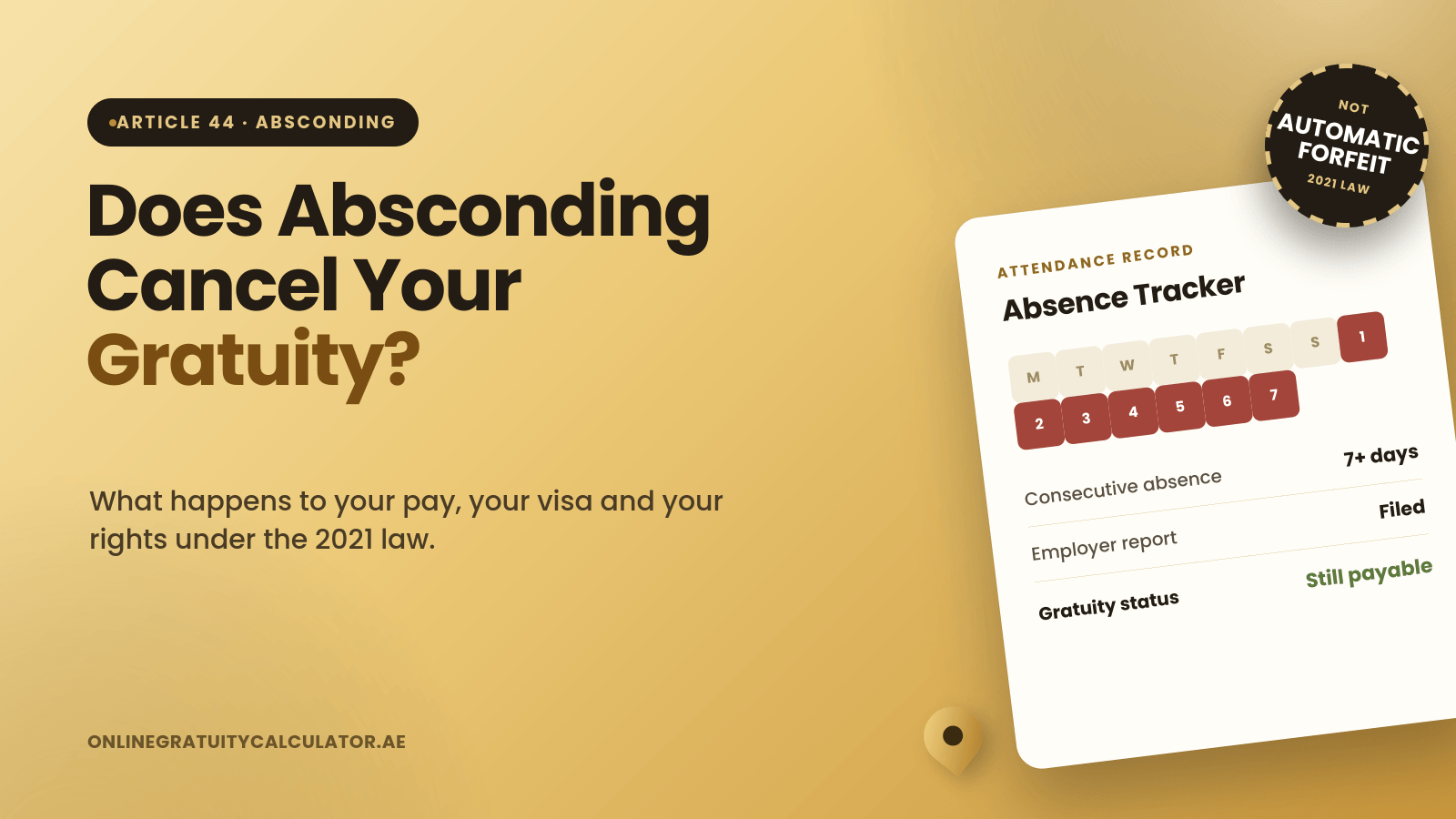
Absconding does not automatically cancel your gratuity. However, an absconding case can create serious employment, work-permit, and immigration-related complications, and it can involve separate claims relating to notice-period compensation or other amounts owed between employer and employee.
What Does Absconding Actually Mean in UAE Law?
In UAE employment law, absconding occurs when an employee stops coming to work without informing the employer and without obtaining approval. It is not simply resigning — it’s abandoning the job entirely with no communication.
Article 44(7) of Federal Decree-Law No. 33 of 2021 defines the specific thresholds:
If either threshold is met, the employer can classify the absence as absconding and file a report with MOHRE. This allows the employer to terminate the employment without notice and can trigger immigration consequences for the employee.
Does Absconding Cancel Gratuity in the UAE?
This is the critical question, and the answer under the 2021 law is: not automatically.
Under the old 1980 law, absconding was treated as a form of misconduct that could forfeit gratuity entirely. The 2021 law changed this. Employees dismissed under Article 44 grounds — which includes absconding — still generally retain their right to gratuity after completing one year of service.
How Is Gratuity Calculated After Absconding?
For an eligible foreign worker, gratuity is generally calculated using the basic wage, rather than the total salary package, as set out in Article 51.
The law also provides for gratuity on parts of a year, in accordance with the statutory conditions.
Worked example
If an employee’s basic monthly salary is AED 5,000, and they’ve completed two years of qualifying service:
| Values | Working | Amount |
|---|---|---|
| Monthly basic wage | — | AED 5,000 |
| Daily basic wage | 5,000 ÷ 30 | AED 166.67 |
| Gratuity for 1 year | 166.67 × 21 | AED 3,500 |
| Total for 2 years | 3,500 × 2 | AED 7,000 |
This is a simplified example. The actual calculation can depend on your service dates, employment arrangement, and applicable law.
What Your Employer CAN and CANNOT Do
Employers CAN
- Dismiss without notice under Article 44 for qualifying unauthorised absence.
- Report the absence through the applicable labour and work-permit procedures.
- Claim notice-period compensation where the required notice wasn’t observed.
- Pursue a documented claim for legally recoverable losses.
Employers CANNOT
- Automatically erase all your statutory end-of-service benefits.
- Deduct any amount they like without following applicable law and procedure.
- Treat an absconding report as equivalent to a criminal conviction.
- Refuse to pay amounts legally due without you having a dispute route.
If an employer refuses to pay an amount you believe is legally due, you can raise the dispute through the appropriate MOHRE complaint and labour-dispute process. The final entitlement depends on the specific facts — salary structure, length of service, termination circumstances, outstanding liabilities, and any decision by the competent authorities.
What Happens to Your Visa or Work Permit?
This is where absconding creates real practical problems. When an employer files an absconding report with MOHRE, this can trigger:
- Work-permit cancellation
- Changes to your employment status
- Difficulty obtaining a new work permit
- Immigration or residency procedures
- Complications resolving the employment relationship normally
How to Clear an Absconding Case
If your employer has filed an absconding case against you, here’s the process to resolve it:
- Step 1 — Contact your employer. If you had a genuine reason for leaving (unsafe conditions, unpaid wages, bullying), they may agree to close the report in exchange for a mutual termination settlement.
- Step 2 — File your own MOHRE complaint. If your employer wasn’t paying your salary or was violating your rights, this creates a counterbalance to the absconding claim.
- Step 3 — Engage a UAE labour lawyer. For significant amounts or complex situations, a lawyer can challenge the absconding designation.
- Step 4 — Attend the MOHRE dispute session. If the employer can’t demonstrate a genuine absconding scenario, the status may be removed.
Can You Leave Without Notice Because of Employer Misconduct?
Yes. Article 45 addresses circumstances in which a worker may terminate the employment contract without notice, subject to statutory conditions and procedures — including situations such as the employer failing to fulfil contractual or legal obligations, and certain forms of assault, harassment, or serious misconduct.
Be careful about assuming any workplace disagreement automatically qualifies under Article 45. If you believe it applies to your situation, documenting the employer’s conduct and using the appropriate complaint process is important.
What Should You Do If You’re Already Listed as Absconding?
- Confirm your current status — find out what’s actually been recorded against your employment or work-permit file.
- Collect your documents — contract, Emirates ID, salary records, resignation communications, and relevant evidence.
- Contact MOHRE and ask about the appropriate procedure for your situation.
- Contact your former employer where appropriate — an amicable settlement may be possible.
- Get professional legal advice for complex cases involving significant claims or immigration complications.
Absconding vs Resignation: What Is the Difference?
These two situations should not be confused — the legal consequences differ significantly.
| Situation | General meaning |
|---|---|
| Resignation | Employee formally communicates their decision to end employment |
| Termination | Employer ends the employment relationship |
| Absence without approval | Employee stops attending work without an accepted reason |
| Article 44 dismissal | Employer dismisses the employee without notice on a statutory ground |
| Article 45 termination by worker | Worker terminates employment without notice where statutory conditions are met |
Conclusion
Absconding is serious, but it is not the end of your employment rights in the UAE. Your gratuity is not automatically cancelled — the 2021 Labour Law removed automatic forfeiture as a consequence of Article 44 dismissal grounds. The practical consequences, like visa flagging, work-permit cancellation, and difficulty finding new work, are often more significant than the legal ones.
Address the absconding case proactively, file your own MOHRE complaint if you had legitimate reasons for leaving, and seek legal advice for complex situations.
Want to know exactly what you’re owed? Use our free UAE Gratuity Calculator to estimate your end-of-service benefit.
Frequently asked questions
Does absconding cancel gratuity in the UAE?
Not automatically. An Article 44 dismissal for qualifying absence doesn’t itself mean an otherwise eligible employee’s statutory gratuity is automatically forfeited. Gratuity entitlement is addressed separately under Article 51.
Can I get gratuity after an absconding case?
You may still have a statutory gratuity entitlement if you meet the requirements under UAE Labour Law, including the required period of continuous service. The exact amount depends on your qualifying service and basic wage.
How many days of absence can lead to Article 44 dismissal?
Absence without a legitimate reason or accepted excuse for more than 7 consecutive days, or more than 20 non-consecutive days.
Does absconding mean I’ve committed a criminal offence?
An employment absence issue shouldn’t automatically be described as a criminal conviction. Labour, work-permit, and immigration consequences can depend on the circumstances and authorities involved.
Can my employer deduct notice pay from my final settlement?
Notice-period compensation is legally distinct from gratuity. Whether a particular deduction can be made depends on the circumstances and applicable UAE labour rules.
Can I challenge an absconding report?
If you believe the report is incorrect or there were legitimate circumstances behind your absence, you can seek clarification and use the appropriate MOHRE dispute or complaint channels.
What if I left because my employer didn’t pay my salary?
Document the unpaid wages and your communications with the employer. UAE Labour Law provides circumstances in which a worker can terminate employment without notice when the employer fails to fulfil certain legal or contractual obligations, subject to statutory requirements.
Can I get a new job after an absconding case?
This depends on your current work-permit, residency, and labour status, and whether the matter has been resolved. Verify your status with the relevant UAE authorities before assuming you can transfer to a new employer.
Tell us what you want to read next
Found a mistake, or want a guide on a specific UAE labour law topic? Send us a message.
Prefer to run the numbers now? Open the calculator →
Contact Us
Have a question about the calculator, found a mistake, or want to suggest an improvement? Send us a message.
Prefer to email directly? info@onlinegratuitycalculator.ae
Last updated: 22 October 2026
Cookie Policy
This policy explains how onlinegratuitycalculator.ae (“we”, “our”) uses cookies and similar technologies, and the choices you have.
1. What are cookies?
Cookies are small text files stored on your device when you visit a website. Similar technologies, such as your browser’s local storage, can also save small pieces of information on your device. They help websites work properly, remember your settings and understand how a site is used.
2. What we use and why
| Name / type | Purpose | Category | Duration |
|---|---|---|---|
| gratuity-theme (local storage) | Remembers whether you chose light or dark mode. | Essential / preference | Until you clear your browser data |
| gratuity-cookie-consent (local storage) | Remembers your cookie choice so we don’t ask again on every visit. | Essential | 12 months |
| Analytics and advertising cookies | Only if we enable them: to understand which pages are used and to improve the site. They are used only after you accept. | Optional | Set by the provider |
The calculator itself runs in your browser. The salary and dates you enter are used only to show your result on screen and are not sent to us.
3. Third-party services
To display the page, your browser loads some resources from other providers, such as Google Fonts (typefaces) and a content delivery network (the library used to create PDF results). When your browser requests these files, those providers receive technical information such as your IP address. Their own privacy policies apply.
Our pages also link to external websites, including UAE government sites. We are not responsible for cookies used on those sites.
4. Your choices
- Use the cookie banner to accept all or keep only essential storage.
- Change your mind at any time with the button below.
- Block or delete cookies in your browser settings. Some features, such as remembering dark mode, may stop working.
5. Changes to this policy
We may update this policy from time to time. The date at the top shows when it was last changed.
6. Contact
Questions about this policy? Use our form.